
Why Corporate Philanthropy is Not a Luxury
It’s a Liability Check
Written by: Melinda D. Whittington
If you look at a balance sheet, you won’t find a line item labeled “human dignity.” You won’t see a metric for “community resilience.”
For most of my career as an accountant and CFO, I was trained to focus on what could be measured. That lens is useful, but incomplete. The longer I’ve spent leading organizations, the more I’ve realized that some of the most important drivers of long-term success are the ones we don’t neatly quantify.
In the furniture industry, we talk constantly about comfort, angles, materials, durability. But there’s a question we don’t ask often enough: why are we so focused on comfort inside the home, while ignoring discomfort outside of it?
For years, corporate engagement in social impact has been treated as optional, something to invest in when times are good or when reputation risk demands it. That approach no longer holds up. Today, a company’s responsibility doesn’t stop at its front doors. If your business succeeds while the communities around you struggle, that gap will eventually show up in your workforce, your brand, and your bottom line.
We’ve seen this firsthand. There is a wide and often overlooked space between families who feel stable and those who are one unexpected event away from crisis. Businesses don’t just operate in that space; they are shaped by it.
Employees are no longer motivated solely by compensation. They want to see that their work contributes to something larger. When companies create meaningful ways for employees to engage with their communities, the impact isn’t abstract. It shows up in retention, in culture, and in long-term loyalty.
And yet, for all this awareness, much of corporate philanthropy hasn’t evolved at the same pace.
The Era of Performative Philanthropy is Over
People can tell the difference between a symbolic gesture and a sustained commitment. Writing a check isn’t inherently wrong, but it’s insufficient on its own. Impact requires consistency, partnership, and a willingness to stay involved long after the announcement is made.
It builds infrastructure by investing in social service agencies and small businesses. As the world becomes more volatile, the strength of the communities we live in becomes our safety net.
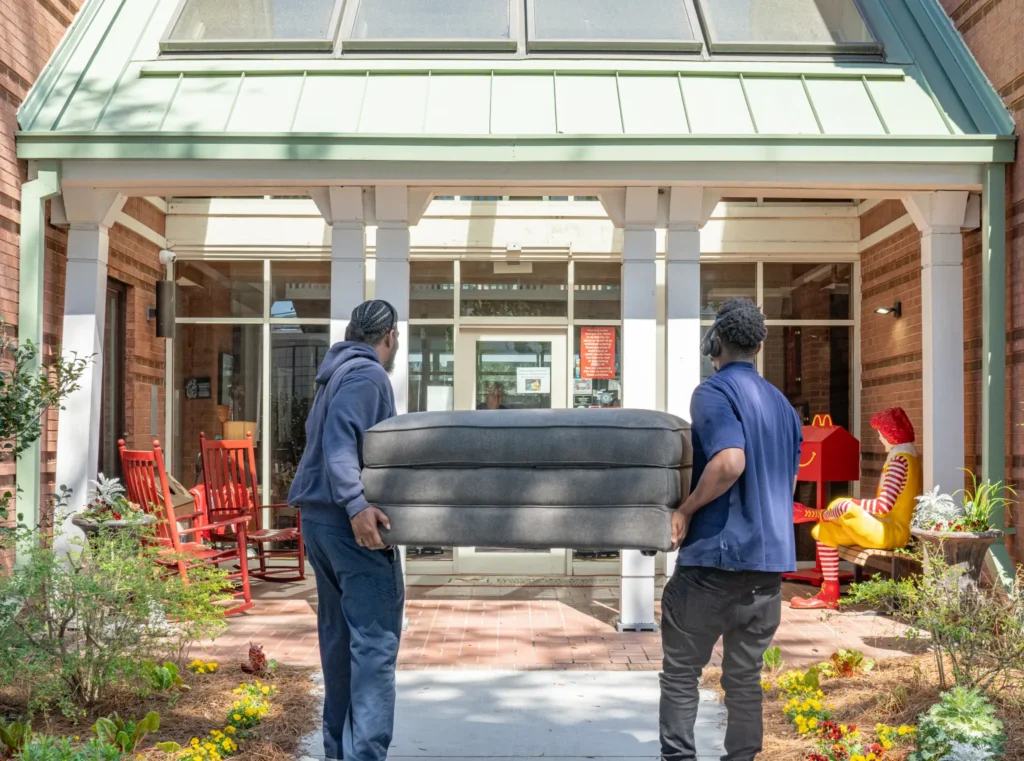
That’s why our approach has shifted toward long-term, embedded commitments. Our five-year, $3.25 million investment in the Ronald McDonald House Charities Family Impact Fund, for example, is designed to support housing stability for families navigating medical crises. But more importantly, it’s structured as an ongoing partnership, one that prioritizes continuity over visibility. Alongside that, we contribute our furniture to help create spaces that feel less like temporary housing and more like home.
Because ultimately, this isn’t about recognition. It’s about relevance.
As economic and social uncertainty increases, the strength of the communities around us becomes more than a moral concern; it becomes a business imperative. Companies that invest in that strength are not stepping outside their role; they are securing it.
And in the end, legacy won’t be defined by how visible a company’s generosity was, but by how deeply it was felt.
Not by the announcements it made, but by the stability it helped create.
Not by the comfort it sold, but by the comfort it extended.
Rationale/Strategy
Based on the 2024 ESG Report, this thought-leadership piece positions La-Z-Boy as a company that prioritizes community impact and employee engagement as core elements of its business strategy. By focusing on corporate social responsibility, specifically charitable giving, the article aligns with La-Z-Boy’s long-standing initiatives, including the La-Z-Boy Foundation, La-Z-Boy Cares, and its partnership with Ronald McDonald House Charities. The piece also highlights how product donations extend the lifecycle of furniture, demonstrating how community support and sustainability can intersect through responsible reuse and reduced waste. This messaging emphasizes that community investment is not simply philanthropy; it is a leadership responsibility that benefits employees, consumers, and local communities alike. Positioning Melinda Whittington, La-Z-Boy’s CEO, as the voice of the piece reinforces the company’s values-driven leadership. As a former accountant, Whittington represents a leader who looks beyond financial success to consider the broader social and community impact of the company, further strengthening La-Z-Boy’s reputation as a purpose-driven brand.
AUTHORS: Melinda D. Whittington is the CEO of La-Z Boy, at La-Z-Boy Incorporated, and the Board chair at Best Buy. Haley Bishop is the Chief Communications Officer at La-Z Boy Incorporated
CONTACT INFO: Melinda D. Whittington: M.Whittington@LaZboy.com, Haley Bishop: hbishop@usc.edu
WORD COUNT: 485